
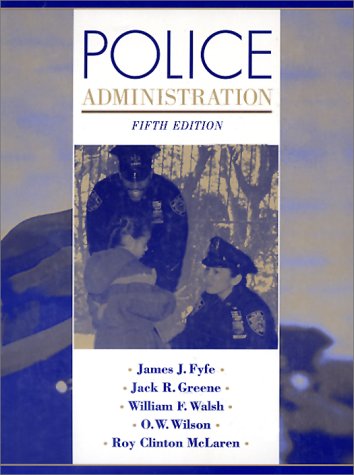
Police Administration
Material type: TextPublication details: McGraw-Hill Co., Inc. 1997ISBN:
- 0070225664
- 355.6 P75 1997
| Item type | Current library | Call number | Copy number | Status | Date due | Barcode |
|---|---|---|---|---|---|---|
 Books |
NORSU Dumaguete (Main Campus II) Circulation Section | 355.6 P75 1997 (Browse shelf(Opens below)) | c1 | Available | NORSU000006525 |
Browsing NORSU Dumaguete (Main Campus II) shelves, Shelving location: Circulation Section Close shelf browser (Hides shelf browser)

|

|

|

|

|

|

|
||
| 355.0019 P95 2006 Psychology in the Service of National Security | 355.00820973 N33 2002 For love of country, confronting rape and sexual harassment in the U. S. Military | 355.343 D42 1999 Information Warfare and Security | 355.6 P75 1997 Police Administration | 362.20425082 M34 2011 Evidence-Based Practice with Women | 362.25 Si1 2010 Forensic Science: the basics | 362.252 Ad1 2004 Crime Scene Investigation |
Includes index.
Part 1. The police role : responsibilities, problems, and relationships. 1. Police : the historical perspective
2. The police role in society
3. The police and politics
Part 2. Leadership and administration. 4. The police chief executive as leader
5. The police chief executive as administrator : theory, practice, and strategies
6. Police research
7. Police planning
8. Financial management and budgeting
9. Personnel management I : hiring and entry-level training
10. Personnel management II : human resource management
11. Productivity and performance measurement
12. Discipline
13. Quality assurance and inspections
14. Police misconduct and integrity control
15. Police standards and accountability
Part 3. Operations. 16. Uniformed services : patrol, traffic, and special operations
17. Crime prevention and criminal investigation
Summary
Questions for discussion
Notes
Sources
Index
This text examines police administration in terms of the police role, police leadership and management, and specific police operations. Chapters on the police explain the origins of the concept and practice of policing, describe the early years of policing in the United States, and discuss police reforms of recent years. They also discuss problems in setting police priorities, and distinguishing the police from other occupations, police work as coercion, the noncoercive work of the police, police accountability, political influences on policing, sources of confusion about police authority, and police relationships with local government and the media. The chapters on police leadership and administration focus on the police chief executive as leader; theory, practice, and strategies related to the police chief's role as administrator; theories of organization and management; and systems of organizational management. They also focus on types of police research, police resistance to behavioral research, the contributions of behavioral research to policing, the police planning process, staffing and organizing the planning function, types of plans, and the impact of computer technology on planning. Further chapters examine financial management and budgeting, police personnel hiring and entry-level training, human resource management, and productivity and police performance measurement. Additional chapters consider police discipline, positive discipline and punishment, quality assurance and inspections, police misconduct and integrity control, and police professional standards and accountability. The chapters on specific police operations detail the patrol, traffic, and special operations of uniformed police, as well as crime prevention and criminal investigation
There are no comments on this title.